


Highly Integrated Precision: The Heart of Solar Monitoring
The Veswe VRS-GFQXZ-EX is a fully integrated photovoltaic weather station engineered specifically for solar power plants. Set against rugged mountainous terrain, its dual-pole structure houses a suite of critical instruments, anchored by a high-precision solar radiation sensor. This industrial weather station delivers the precision measurement and real-time monitoring essential for optimizing PV plant efficiency. Unlike basic setups, this system features a modular design where the solar radiation sensor works in harmony with wind and temperature gauges to provide a complete meteorological picture. Powered by solar energy with battery backup, this solar powered weather station ensures uninterrupted operation even in remote locations. Whether deployed as a commercial weather station for urban rooftops or a remote weather station in the desert, its reliability is unmatched. At its core, the solar radiation sensor captures every photon with accuracy, acting as the primary data source for yield calculations. As a professional weather station, it sets the standard for data integrity, ensuring that every reading from the solar radiation sensor reflects true sky conditions.

Multi-Parameter Flexibility: Customizable Sensor Suites
This weather monitoring system supports customizable sensor suites to match project-specific needs. Icons illustrate monitored elements: Solar Tilt Radiation, Sunshine Duration, Total Solar Radiation, Direct Solar Radiation, Diffuse Solar Radiation, Atmospheric Pressure, Wind Speed, Wind Direction, Temperature, Humidity, and GPS Coordinates. The text emphasizes flexibility: “Monitoring elements are freely adjusted according to requirements.” Crucially, the dual-pole setup allows optimal spacing between the solar radiation sensor and anemometers to prevent interference, ensuring clean, uncontaminated datasets. This configuration is vital for accurate performance ratio calculations. Whether you need a meteorological station for research or an industrial weather station for utility-scale farms, the layout adapts. The solar radiation sensor remains uncontaminated by wind turbulence, providing pure irradiance data. As a flexible commercial weather station, it fits any site, but the precision of the solar radiation sensor remains the constant priority across all configurations.

Automated Sun Tracking: Dual-Mode High-Precision Alignment
Against a cosmic backdrop, the system highlights its advanced tracking capability, centered around a sophisticated solar radiation sensor mount. It adopts a fully automatic solar tracking system that follows the sun, eliminating manual maintenance. It uses both sensor-based tracking and GPS solar trajectory methods (north of the Tropic of Cancer) to guarantee high-precision alignment. This dual-mode redundancy ensures the solar radiation sensor captures maximum irradiance accurately—critical for validating module performance. As a cutting-edge automatic weather station, it outperforms fixed units by constantly adjusting the angle of the solar radiation sensor to face the sun directly. Whether acting as a meteorological station or a commercial weather station, tracking is seamless. The solar powered weather station maximizes every ray because the solar radiation sensor never loses the line of sight. This automated weather station logic ensures that the solar radiation sensor always operates at peak efficiency, providing the most accurate tilt radiation data possible.

Versatile Power Options: Off-Grid Resilience Anywhere
Designed for deployment flexibility, this weather monitoring system offers three power modes to solve electricity challenges anywhere: 220V AC Mains Power, Lithium Battery Backup (≥2 days runtime), and Solar Panel Charging for self-sustaining off-grid operation. Visuals show the unit operating autonomously in a desert, reinforcing its suitability as a remote weather station where grid access is limited. Users can select the optimal configuration based on site infrastructure. The solar radiation sensor keeps working even when the grid fails, powered by the station’s own PV panel. As a resilient industrial weather station, it powers itself to ensure continuous data logging. Whether used as a commercial weather station or a meteorological station, uptime is guaranteed. The solar powered weather station design means the solar radiation sensor is truly independent, capable of surviving blackouts and cloudy periods while maintaining its vigilance over the sun.

Dual-Pole Structural Resilience: Built for Extreme Weather
Set against stormy skies, the image underscores the structural resilience of this industrial weather station. The high-strength dual-pole mounting frame resists strong winds, heavy rain, snowfall, and extreme weather, enabling long-term outdoor deployment. The dual vertical poles separate sensitive instruments, ensuring the solar radiation sensor operates without cross-interference from wind vanes while maintaining mechanical stability. Powder-coated aluminum alloy construction provides corrosion resistance, essential for coastal or alpine installations. As a rugged commercial weather station, it stands firm against the elements. Whether deployed as a meteorological station or a remote weather station, stability is key. The solar powered weather station withstands the harshest climates, protecting the delicate optics of the solar radiation sensor inside its robust housing. Trust this professional weather station to keep the solar radiation sensor steady and safe, no matter how hard the wind blows.

Wide-Ranging Applications: From PV Plants to Research
This versatile weather monitoring system demonstrates utility across four key scenarios: Photovoltaic Power Generation, Solar Energy Monitoring, Climate Change Research, and Substation Revenue Assessment. Each use case reinforces the role of the solar radiation sensor as a foundational tool for data-driven decision-making. Whether for O&M teams using an industrial weather station or researchers with a meteorological station, data is king. This commercial weather station drives financial reconciliation by providing accurate irradiance data from the solar radiation sensor. As a precise remote weather station, it supports scientific study. Trust this professional weather station for investor reports, where the data from the solar radiation sensor validates the plant’s performance. Every application relies on the solar radiation sensor to turn raw sunlight into actionable intelligence, optimizing cleaning schedules and inverter dispatch.

Free Cloud Platform: Real-Time Dashboard & Map Visualization
Veswe offers a complimentary cloud-based platform accessible via web or app, transforming this weather monitoring system into a smart IoT solution. Real-Time Data Monitoring displays live readings: Wind Speed, Temp, Humidity, and crucially, data from the solar radiation sensor (e.g., 654 W/m²). Real-Time Map Display uses GIS to visualize geographic distribution of multiple stations, allowing centralized oversight of distributed assets. Click any pin to view status or trends. Perfect for utility-scale portfolios managed via an industrial weather station network. Whether overseeing a commercial weather station fleet or a single remote weather station, visibility is total. This solar powered weather station connects globally, streaming data from the solar radiation sensor instantly to your dashboard. Trust this professional weather station interface for clarity, where the solar radiation sensor readings are always front and center for immediate analysis.

Advanced Alerting & Video Integration: Proactive Risk Management
Proactive risk management is key. When measurements from the solar radiation sensor or other instruments exceed thresholds (e.g., wind >25m/s, temp >60°C), the system triggers alerts via platform pop-ups, SMS, and email. All events are logged for audit trails. Additionally, Video Surveillance Overlay supports IP camera integration, superimposing sensor data onto live video feeds. Operators can visually correlate environmental conditions (e.g., dust accumulation) with physical site states. This feature makes the industrial weather station a command center. Whether managing a commercial weather station or a meteorological station, safety is automated. The solar powered weather station warns before failure, often triggered by anomalies detected by the solar radiation sensor. Trust this remote weather station for rapid response, ensuring that any drop in performance flagged by the solar radiation sensor is investigated immediately.

Historical Analytics: Query, Graph, and Export
Data is only powerful if you can analyze it. The backend offers Historical Data List View (tabular records), Historical Curve View (line graphs for trends like daily irradiance profiles from the solar radiation sensor), and a Data Export Function (one-click export to PDF, Excel, CSV). Users can generate compliance reports or investor presentations without manual compilation. This analytical depth defines a true industrial weather station. Whether for a commercial weather station audit or meteorological station research, reporting is easy. This solar powered weather station archives everything, creating a long-term history of the solar radiation sensor performance. Trust this remote weather station for historical truth, where years of data from the solar radiation sensor can be exported to prove asset value or identify seasonal patterns.

Centralized Command: Large-Screen Visualization & Node Config
The final module features Large-Screen Visualization designed for control rooms, showing nationwide station locations with color-coded status and dynamic curves for temp, humidity, and the solar radiation sensor. Platform Node Settings allow administrators to configure sampling intervals, alarm thresholds, and user permissions for hundreds of sites via bulk editing. This scalability streamlines management of any industrial weather station fleet. Whether controlling a commercial weather station network or a meteorological station grid, command is centralized. This solar powered weather station scales effortlessly, allowing you to adjust the sensitivity of the solar radiation sensor across an entire portfolio with a few clicks. Trust this remote weather station interface for bulk operations, ensuring every solar radiation sensor in your network is synchronized and optimized for maximum data fidelity.


The current version of the PV Weather Station only supports use in areas north of the Tropic of Cancer.
- Solar panel + mounting bracket
- 1.5m vertical pole + 1m extension pole + 1.3m vertical pole + 1m crossbeam + expansion screws
- Plastic spray waterproof box + key + two clamps + screw bag
- Battery * 1
- U-shaped card (the number of U-shaped cards is based on the actual selection)
- Solar radiation shield * 1
- Wind speed sensor * 1
- Wind direction sensor * 1
- Solar total radiation sensor * 1
- Tilt radiation sensor * 1
- Solar tracker * 1
- Direct radiation sensor * 1
- Scattered radiation sensor * 1
- Component temperature * 1
- Warranty card and certificate of conformity
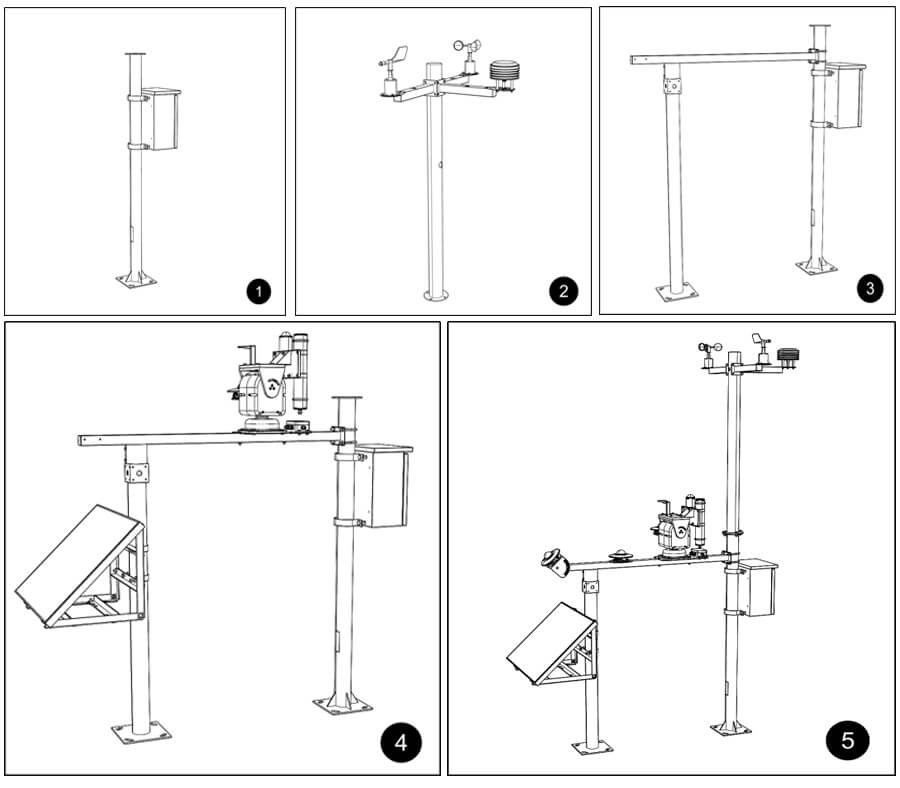
When installing the whole set of equipment, choose a flat location without any surrounding obstructions and ensure it faces south.
The fully automatic tracking solar radiation sensor is a device that automatically tracks the sun and measures multiple solar radiation parameters. Using solar tracking (light tracking) and GPS tracking, it can automatically calculate the solar altitude angle, azimuth, sunrise and sunset time, and analyze and compare the changes in solar light intensity.
The solar direct radiation sensor uses the thermoelectric principle and can be used to measure solar radiation in the spectral range of 0.3~3μm. The sensing element adopts a winding electroplated thermopile, and the sensing surface is a black coating with high absorption rate. The thermal effect of radiation is used to absorb solar radiation and convert it into a temperature difference electromotive force. It can measure the amount of solar radiation more accurately. The use of multi-layer shading rings and light alignment technology ensures the accuracy of direct radiation measurement.
Please email us for manual.


 English
  Arabic
  French
  German
  Hindi
Hindi  Italian
  Korean
  Portuguese
  Russian
  Spanish
  Thai
Thai  Vietnamese
  Indonesian
  Malay
Malay  Polish
  Turkish
  Swedish
  Japanese


