


Industrial-Grade Precision: Remote Monitoring & Customizable Depth
The Veswe Soil Tensiometer is an industrial-grade device designed for accurate measurement of soil water potential using negative pressure principles. Set against rolling green fields, its transparent PVC tube connects to a stainless steel vacuum gauge and an RS485/4-20mA output head. This soil tensiometer offers four key advantages: remote monitoring for cloud integration, precise measurement (±0.5kPa accuracy), IP67 protection for harsh environments, and customizable lengths (15cm to 120cm+) to match any root zone. Ideal for precision irrigation scheduling and drought stress prediction, this tensiometer for soil provides energy-based metrics that outperform volumetric sensors. Whether you need a simple gauge or a networked tensiometers solution for automation, this device delivers the versatility and scientific accuracy required for modern agriculture.


High-Quality Clay Head: The Heart of Accurate Sensing
Close-up views reveal the porous ceramic tips attached to clear tubes—the critical sensing interface of this soil tensiometer. The text explains: “The clay head is the sensing part… sensitivity depends on water permeability.” Four key features define its performance: high sensitivity to minute suction changes, fast water penetration for rapid equilibration, an airtight seal to maintain vacuum integrity, and a small error margin for consistent readings. Essential for maintaining long-term accuracy, this tensiometer for soil thrives even in saline or compacted soils. The quality of the ceramic head determines whether your tensiometer soil moisture data remains reliable season after season.

Transparent PVC Pipe & Stainless Steel Gauge: Visual Clarity Meets Durability
Highlighting dual-material construction, this soil tensiometer combines functionality with robustness. The transparent PVC tube allows visual observation of the internal water level, enabling fast response speeds and effective perception of the soil environment. Users can instantly verify saturation without tools. The mechanical vacuum gauge, made of corrosion-resistant stainless steel, is suitable for prolonged outdoor use. Its face displays a kPa scale (-100 to 0) with color-coded zones for intuitive field reading. This hybrid design supports both manual verification and automated logging, making it a practical soil tensiometer for growers who value immediate visual feedback alongside digital data.

Smart Chip: Low Power, High Sensitivity, Stable Transmission
Featuring a glowing MCU chip graphic, this soil tensiometer showcases its intelligent signal processing. An imported low-power MCU chip delivers low power consumption (max 0.8W for RS485, 0.5W for 4-20mA), making it ideal for solar or battery-powered stations. High sensitivity captures shifts down to 0.1kPa resolution, while noise-immune signal transmission ensures clean data over long cable runs (up to 2000m for RS485). This smart soil tensiometer enables seamless IoT integration, allowing your tensiometer for soil network to operate reliably even in remote, off-grid locations.

IP67 High Protection Level: Built for Harsh Field Conditions
Showing the sensor half-submerged in splashing water, this soil tensiometer proves its ruggedness. The body is treated with waterproof and dustproof measures, protecting internal components and ensuring normal operation even when buried long-term. The IP67 rating allows deployment in flooded paddies, muddy orchards, or coastal saline soils where lesser enclosures fail. Combined with UV-stable PVC and stainless fittings, this soil moisture sensor for irrigation system withstands seasonal extremes without degradation—ensuring your tensiometer soil moisture data remains consistent year after year.

Measurement Is More Accurate: Unaffected by Salts & Fertilizers
Illustrating the sensor in a grassy soil profile with floating “Salt Ion” bubbles, this soil tensiometer demonstrates immunity to chemical interference. Unlike EC or capacitance probes, tensiometers measure physical water tension, making them uniquely suited for high-salinity greenhouse substrates, compost-amended beds, or reclaimed wastewater schemes where conductivity-based sensors give false readings. As a chemically inert soil moisture probe, it provides accurate data regardless of fertilizers, pesticides, or irrigation water quality. For growers dealing with saline soils, this is the best soil moisture probe you can rely on.

Fast Response Speed: Humanized Design for Easy Maintenance
Diagram labels user-serviceable parts for quick refilling: unscrew the top cap, remove the silicone plug, inject cooled boiled water, and reseat. The transparent shell allows intuitive water level monitoring between refills. No special tools are required—farmers can maintain units onsite within minutes, ensuring continuous data continuity. This humanized design makes it an easy-to-maintain soil moisture sensor probe for busy operations. Whether you’re using it as a tree moisture probe in orchards or a professional soil moisture meter in research plots, upkeep is simple and fast.

Real-Time Reflection of Soil Conditions: Determine Irrigation Needs
Depicting the sensor installed with the gauge visible above ground, this soil tensiometer is ready for immediate interpretation. It determines field or potting soil water suction and provides indicators for irrigation, monitoring soil moisture dynamics including soil water and groundwater. Applications include triggering drip emitters when tension exceeds thresholds, validating evapotranspiration models, and studying capillary rise. This direct insight into plant-available water is more meaningful than % volume alone—making it an essential tool for any soil moisture monitoring system.

Remote Real-Time Monitoring: Web/App Integration for Automation
Displaying dashboard interfaces across desktop, tablet, and smartphone, this soil tensiometer supports remote viewing via web, app, and mini-programs. It links soil conditions to water-fertilizer integrated machines and smart agricultural systems to realize automated irrigation. This enables scalable farm management: connect multiple tensiometers to a central controller, auto-adjust valves based on real-time demand, and reduce labor costs. As a connected soil moisture sensor for irrigation system, it brings the field to your phone—making it the ideal choice for modern irrigation system moisture sensor networks.

Soil Water Potential Reference Guide: Interpret Readings for Action
Four panels provide actionable thresholds based on measured kPa values, serving as a quick-reference chart for growers interpreting gauge readings or configuring software alarms:
Reading Condition Action
-10 ~ 0 kPa Humidity/high moisture Suitable for most crops, but watch for waterlogging
-30 ~ -10 kPa Wet / ideal growth range Majority of plants thrive here
-50 ~ -30 kPa Dry Wet-loving crops need watering soon
< -50 kPa Very dry Most crops require urgent irrigation
This guide bridges the gap between raw data and agronomic action. Whether you’re using a soil ph analyzer alongside your tensiometer or relying solely on this soil moisture sensor irrigation tool, these ranges provide universal guidance. For any soil sensors for agriculture setup, understanding these thresholds transforms your soil moisture data into confident irrigation decisions.


Soil tension is the soil water potential, which is an index of soil moisture intensity. Its size is closely related to the fluidity and penetration depth of soil moisture, the effectiveness and difficulty of plants to absorb soil moisture. At the same time, it can indirectly reflect soil moisture. Generally speaking, the lower the soil moisture, the greater the soil tension, and the stronger the water suction, making it difficult for plants to absorb water in the soil. The greater the soil moisture, the weaker the soil’s suction power for water, and the easier it is for crops to absorb water from the soil.
A soil tensiometer is an instrument that measures soil water tension (or matric potential), which indicates how strongly water is held in the soil and how difficult it is for plants to extract it.
- The soil tension is composed of a pressure gauge, a PVC pipe and a ceramic probe. After the PVC pipe is filled with water, the ceramic probe is moist and can prevent external air from entering the ceramic probe. When there is a pressure difference between the water potential of the tested soil and the tensiometer, the water in the tensiometer penetrates into the tested soil until it reaches an equilibrium state. At this time, the value displayed by the pressure gauge is the water potential of the tested soil.
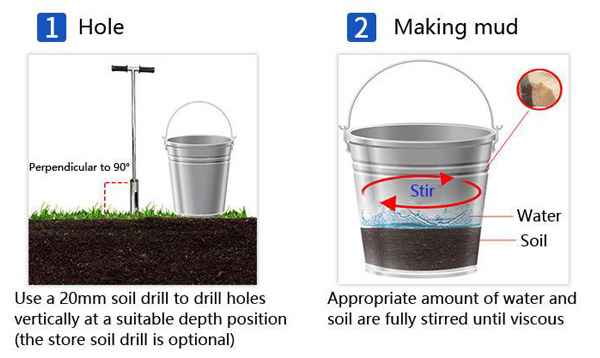
1. Install the device after crop sowing.
2. Choose a location with flat terrain.
3. Under full-field irrigation, prioritize areas receiving relatively less water as monitoring sites. Under localized irrigation, select a spot within the irrigated zone.
4. Select a location where crop growth is uniform and representative of the majority of crops.
5. Consider the root distribution of the monitored crop; generally, choose a spot close to the crop’s water-absorbing roots.
Note: The soil tensiometer should be installed at a relatively elevated location to prevent rainwater backflow into the device, which may cause short circuits or circuit failures.
4~20 mA Output
Yellow wire: Power positive (10–24 VDC)
White wire: 4–20 mA signal output
RS485 เอาต์พุต
Brown wire: Power positive (10–24 VDC)
Black wire: Power negative
Yellow (or green) wire: RS485-A
สายสีฟ้า: RS485-B
Tensiometers indirectly measure soil moisture tension. After the tensiometers are installed, they can provide readings at the same location for a long period of time. Tensiometer readings are easy to interpret and indicate the soil moisture conditions experienced by plant roots. Soil salinity does not affect the reading.


 English
  Arabic
  French
  German
  Hindi
Hindi  Italian
  Korean
  Portuguese
  Russian
  Spanish
  Thai
Thai  Vietnamese
  Indonesian
  Malay
Malay  Polish
  Turkish
  Swedish
  Japanese


