Penderia Bunyi
Penderia Bunyi Harga asal ialah: $43.00.Harga semasa ialah: $33.00.
Kembali ke produk
Penderia Kebolehlihatan Atmosfera
Penderia Kebolehlihatan Atmosfera Harga asal ialah: $2,000.00.Harga semasa ialah: $1,200.00.

Penderia PAR

The Veswe PAR Sensor is precision-engineered to measure photosynthetically active radiation, capturing light intensity in the critical 400–700 nm spectral range essential for plant growth. It offers a wide measurement range of 0–2500 μmol/(m²·s), ensuring accuracy in both low and high light conditions.

Housed in a robust full aluminum casing, this sensor provides excellent waterproof performance for reliable long-term outdoor deployment. It supports versatile integration with multiple signal outputs (RS485, 0–5V, 0–10V, 4–20mA), making it ideal for greenhouses, agronomy research, and environmental monitoring systems.

  • Model: VRS-GH-&-AL-EX
  • MOQ: 1 unit
  • Tarikh penghantaran: dalam masa 24 jam
  • Tanya Harga Sekarang

Siasatan: E-mel: contact@veswe.com | WhatsApp: +8613418148929

Overview - PAR Sensor

This par sensor can be used alone for outdoor monitoring of radiation driving photosynthesis, or it can be used with a fixed weather station. Get accurate and cost-effective measurements of photosynthetically active radiation (PAR) from all light sources used to grow plants.

PAR sensor features

  • The PAR (photosynthetically active radiation) sensor adopts the principle of photoelectric induction. The par sensor working principle: when there is light, a voltage signal proportional to the intensity of the incident radiation is generated, and its sensitivity is proportional to the cosine of the direct angle of the incident light. This par sensor uses high-precision photoelectric sensing elements, with high absorption in the 400-700nm spectral range and good stability. The shell adopts special treatment to reduce dust adsorption and effectively prevent the external environment from damaging the internal components.

PAR sensor parameters

Bekalan kuasa7V~30V DC (0-10V only accept 24V DC power)
Isyarat keluaranRS485/4~20mA/0-5V/0-10V
Penggunaan kuasa485 output: 0.06W, 4~20mA/0~5V/0~10V: 0.7W
Working temperature-25°C~60°C
Response spectrum400nm~700nm
Measuring range0~2500μmol/㎡·s
Resolusi1μmol/㎡·s
Ketepatan±5%(1000umol/㎡·s, @550nm,60%RH,25℃)
Masa tindak balas0.1s
Linearity≤±1%
Annual stability≤±2%
Panjang kabel60cm (customizable)

The protection level of this photosynthetically active radiation sensor can reach IP67, which can ensure that the equipment will not be immersed in water for 30 minutes at a depth of less than 1m without water ingress. It is widely used in the research of meteorology, agriculture, air pollution, and other fields. If you need more information, please contact us.

Mengapa memilih kami?

High accuracy

The built-in sensor adopts high-precision photoelectric sensing element, which has high spectral responsivity and sensitive response to the spectrum of 400~700nm. A high-quality cosine corrector is used to ensure a standard cosine response, which greatly reduces the measurement error.

sijilan

Our PAR Sensor have various certifications, such as Pensijilan ISO9001, RoHS, FCC, CE dan sebagainya. Produk-produk tersebut telah diuji oleh Institut Metrologi Kebangsaan dan adalah tepat serta boleh dipercayai.

Pengeluar OEM

Kami adalah Pengeluar OEM, so we can offer you the best PAR Sensor price. We have big in stock, can ship immediately. If you are confused about which PAR Sensor to choose, we can assist you in finding the right sensor for your requirements. Contact us!

perkhidmatan yang disesuaikan

Kami mempunyai barisan pengeluaran berskala besar dan kakitangan R&D profesional. Jadi kami boleh menyediakan perkhidmatan yang disesuaikan, seperti: logo, label, penampilan, fungsi, dan sebagainya. Jika anda ingin melaksanakan pembangunan sekunder, kami boleh menyediakan anda dengan pakej pembangunan sekunder.

Long using life

The overall housing of the Renke PAR sensor is made of a special aluminum alloy that will not accumulate dust and rain. This keeps the sensor clean and minimizes errors caused by dust blocking the radiation path. It can also work normally in harsh environments.

Remote monitoring

The par sensor can be connected to the customer’s own data device or use the free cloud platform we provide. Easily access data remotely, so you can view data through computer/APP anytime, anywhere. Accurate indoor/outdoor PAR measurement.

FAQs - PAR Sensor

What is photosynthetically active radiation?

The spectral components of solar radiation that are effective for plant photosynthesis are called photosynthetically active radiation, with a wavelength range of 380-710 nanometers, which basically coincides with visible light. The proportion of photosynthetically active radiation in the direct solar radiation increases with the increase of the sun’s altitude angle, up to 45%. In the scattered radiation, the proportion of photosynthetically active radiation can reach as much as 60~70%.

Can PAR be estimated from total shortwave radiation?

It is better to measure PAR and total shortwave radiation (PYR); however, PAR can be estimated from total shortwave radiation by using a physically-based model.

Why is PAR important for plant growth?

PAR directly influences the rate of photosynthesis. Higher PAR levels generally promote faster plant growth, while insufficient PAR can slow growth, reduce yields, and cause weak plant structures. It is a critical parameter in agriculture, horticulture, and controlled environment farming.

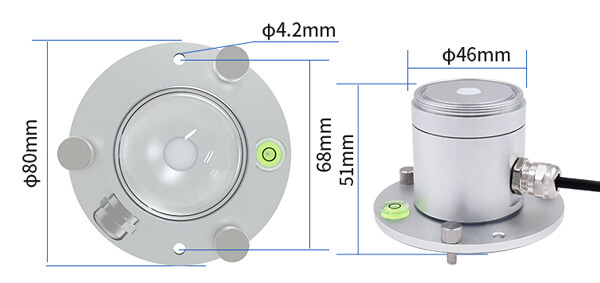
What are the dimensions of this photosynthetically active radiation sensor?

veswe PAR sensor size as below:

par sensor size

How to install this photosynthetic active radiation sensor?

1. Secure the sensor to the mounting bracket using screws through the mounting holes on the sensor.
2. Make sure the device is parallel to the ground (adjust the hand screw and check the level of the bubble to determine whether it is parallel).
3. After installation, remove the protective cover.

How are photosynthetically active radiation sensors calibrated?

Our photosynthetic radiation sensors have been calibrated before leaving the factory, and can be used directly without the need for secondary calibration by customers.

How to maintain photosynthetically active radiation sensor?

For the par sensor that has been used in a windy and sandy environment for a long time, you can regularly wipe the sensor housing with a soft damp cloth to avoid the accumulation of sand and dust. Periodically check for level and for loose screws.

What are the advantages of Renke PAR sensor?
  • 1. Response spectrum range: 400-700nm.
    2. All-aluminum housing, IP67 protection.
    3. Built-in level and adjustment knob for easy on-site adjustment.
    4. Multiple output signal options.
    5. High-quality cosine corrector ensures standard cosine response.
    6. Wide-voltage power supply: DC7-30V.
Where is photosynthetically active radiation used?

1. Applied to plant photosynthesis research, vegetation index research, etc.
2. Application in greenhouse
3. Application in agricultural production

Do PAR sensors measure light quality as well as quantity?

Standard PAR sensors measure total photon flux within 400–700 nm but do not provide spectral distribution. To measure specific wavelengths (e.g., red/blue ratio), a spectroradiometer is required.

What is the difference between PAR and Lux measurements?

Lux measures light intensity as perceived by the human eye, which is sensitive mainly to green light. PAR measures photon flux in the spectrum plants use for photosynthesis. Lux readings are not a reliable substitute for PAR in plant growth applications.

Penderia persekitaran popular

Pengetahuan Industri

Hubungi kami

Rakan sekerja kami: Jack
Telefon/WhatsApp: +86 13418148929
E-mel: contact@veswe.com
Alamat: Tingkat 1–4, No. 269 Lebuhraya Nanda, Jalan Dashi, Panyu, Guangzhou, Guangdong, China