


Solar radiation refers to the sun transmitting energy in the form of electromagnetic waves, and the electromagnetic waves and particle streams emitted by the sun into the universe. The energy transferred by solar radiation is called solar radiant energy. The value of the solar constant published by the World Meteorological Organization (WMO) in 1981 is 1368 W/m2. More than 99% of the solar radiation spectrum of the upper boundary of the earth’s atmosphere is between 0.15 and 4.0 microns in wavelength. About 50% of the solar radiation energy is in the visible spectrum (wavelength 0.4~0.76 microns), 7% is in the ultraviolet spectrum (wavelength <0.4 microns), 43% is in the infrared spectrum (wavelength> 0.76 microns), and the maximum energy is at a wavelength of 0.475 Micron.
The annual total solar radiation refers to the amount of solar radiant energy obtained in an area of 1 square centimeter in a year. Based on this, the distribution of the total solar radiation in a region or a country can be analyzed. There are two parts of solar radiation reaching the ground: one is that the sun is directly projected onto the ground in the form of parallel rays, which is called direct solar radiation. The second is that part of the energy of solar radiation is scattered in all directions with these particles as the center when it encounters air molecules or tiny dust. Part of the energy after scattering is projected from the sky to the ground, called scattered radiation, the sum of the two Called total radiation. It is the solar radiation that reaches the ground, of which direct radiation accounts for the main part.
Pyranometer is a device that measures solar irradiance from a hemispherical field of view incident on a flat surface. The SI units of irradiance are watts per square meter (W/m²).
The main difference between a pyranometer and a pyrheliometer is the purpose of measurement. Pyranometer is used to measure global solar radiation and hence it is used for both visible and UV. Pyrheliometer is used to measure direct solar radiation.
For RS485 Output:
The brown wire connects to the power supply positive terminal (7–30V DC), the black wire to the power supply negative terminal, the yellow (or green) wire to RS485-A, and the blue wire to RS485-B.
For Analog Output:
The brown wire connects to the power supply positive terminal (10–30V DC), the black wire to the power supply negative terminal, the blue wire to the signal positive, and the yellow (or green) wire to the signal negative.
Our solar radiation sensor is IP65.
In order to protect the patented technical parameters, please contact us for a manual.
- 1. When customers receive the product, please confirm the product model, etc.
2. Do not connect the wires with power on. Only turn on the power after the wiring is checked.
3. The sensor is a precision device. Do not remove the protective transparent cover at will.
4. If the reading value is 0, check whether there is a light source and whether the product protective cover is removed.
5. The 485 bus is disconnected, or the A and B lines are connected in reverse.
6. Check whether the power supply meets the marking.
- 1. The wiring method is incorrect or the wiring sequence is wrong.
2. The power supply voltage is incorrect (24V is used for 0-10V models).
3. The distance between the solar radiation sensor and the collector is too long, causing signal disorder.
4. The data acquisition port is damaged.
5. The equipment is damaged.
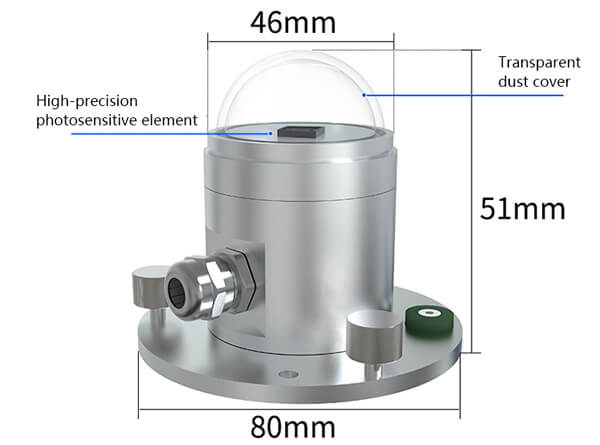
The dimensions of the VRS-RA-&-AL-EX solar radiation sensor are as follows:


 English
  Arabic
  French
  German
  Hindi
Hindi  Italian
  Korean
  Portuguese
  Russian
  Spanish
  Thai
Thai  Vietnamese
  Indonesian
  Malay
Malay  Polish
  Turkish
  Swedish
  Japanese


